Genuine, original William Hogarth engravings and etchings from Darvill's Rare Prints
|
|||||||
|---|---|---|---|---|---|---|---|
| The Analysis of Beauty | |||||||
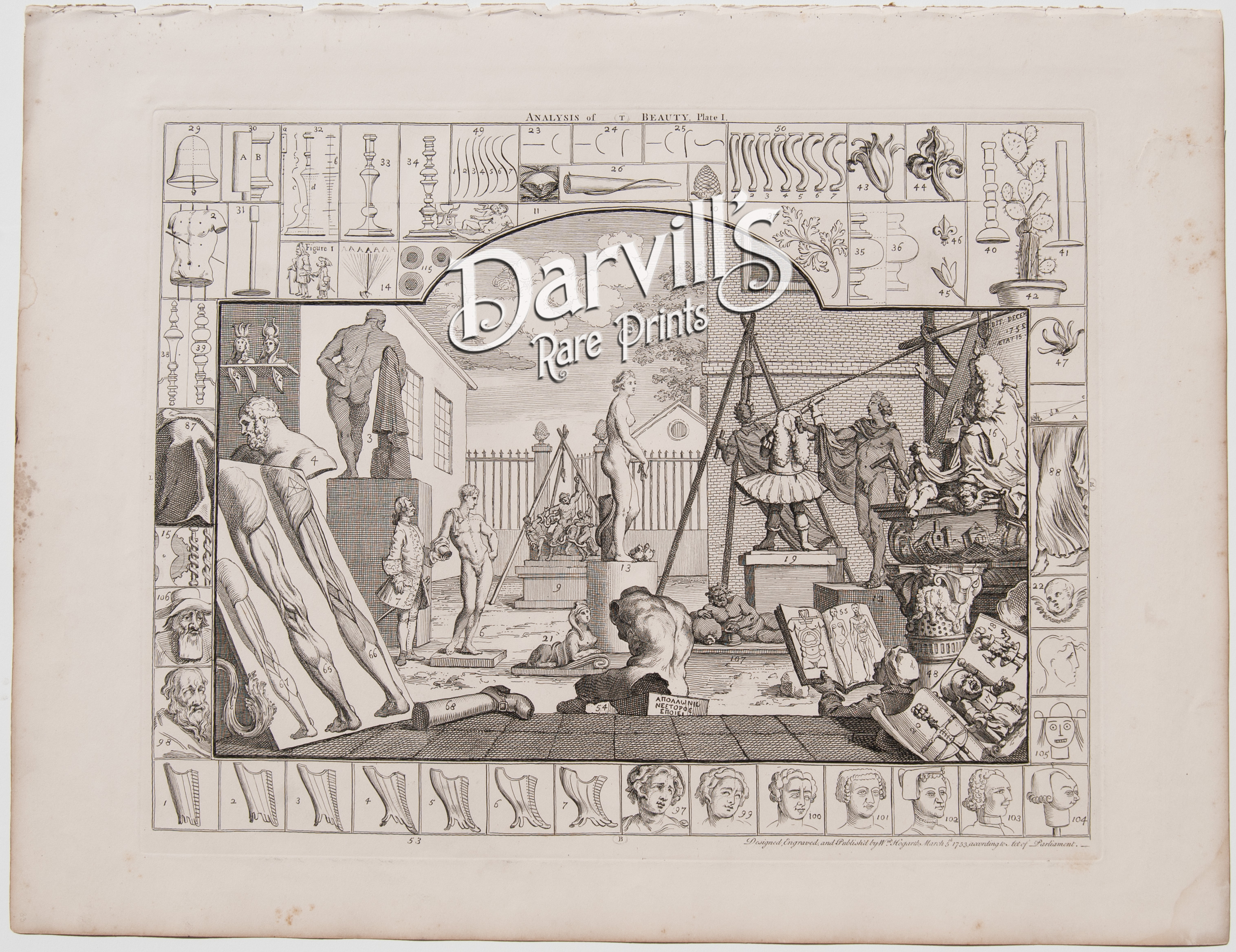
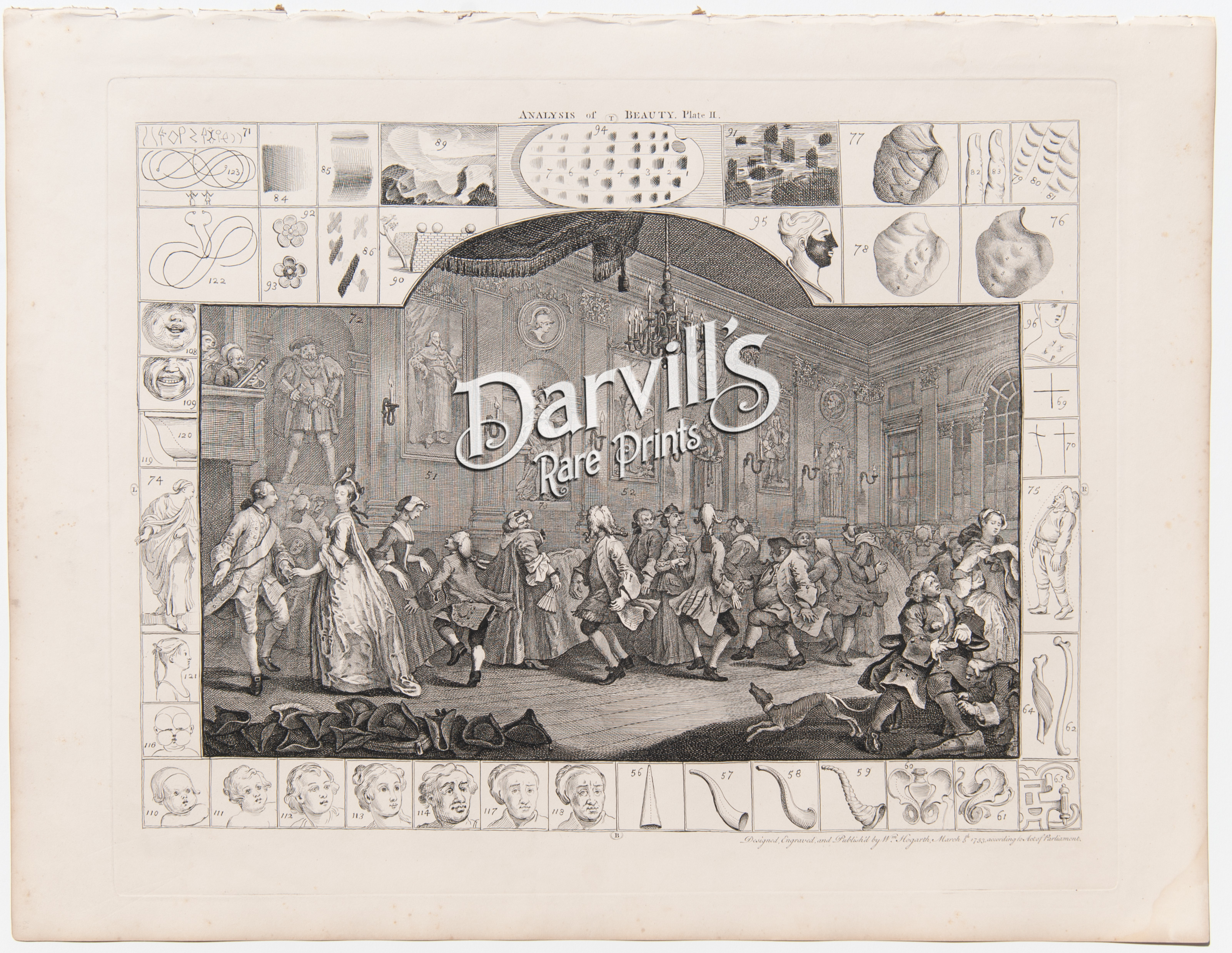
| These two prints were designed as illustrations for Hogarth's aesthetic treatise The Analysis of Beauty. Sold separately from the book, because of their comic and serious interests, they were intended as independent collector's items to be appreciated in their own right and as illustrations to be bound into the Analysis. |
|||||||
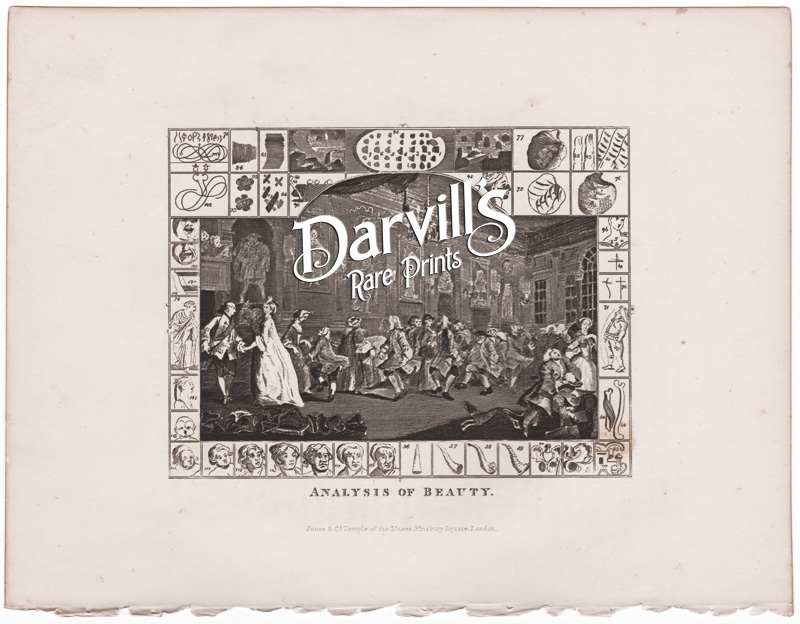
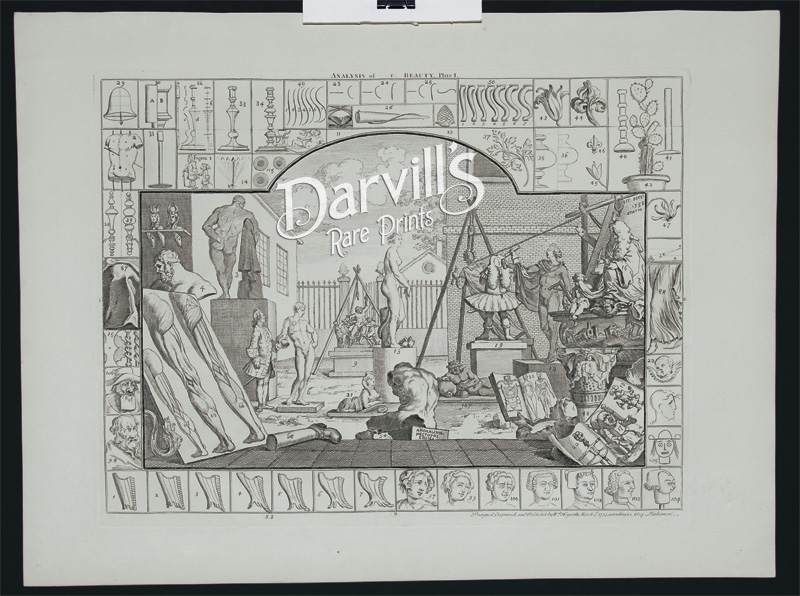 (click image to enlarge— Darvill's electronic watermark does not appear on actual engraving) Analysis of Beauty ANALYSIS OF BEAUTY (PLATE I) This print depicts a statuary yard in which Hogarth has collected the various artifacts he wishes to comment on. The scene is believed to have been inpired by Socrates' discussion of beauty stimulated by the art objects in the yard of his friend Clito; the dialogue was translated from Xenophon's Memorabilia by Dr. Morell, a friend of the engraver. The yard contains the dignified classical sculptures known to the age with a miscellaneous and often comical assortment of modern art objects. In the center stands the Medicean Venus. To the right are statues of Julius Caesar hanging from a pulley and Apollo Belvedere. A short, overdressed Brutus stands on one side of Apollo over the falling Caesar; on the other side another overdressed figure clad as a judge sits with his foot on the head of a cherub. A second putto with a gallows in its hand cries at the judge's feet. The Laocoön stands behind the Venus; on either side of the Venus lie a graceful sphinx and the satyr Silenus reclining on a wineskin. In the foreground rests "Michaelangelo's torso" by "Apollonius, son of Nestor." Beneath the Farnese Hercules a dancing master attempts to correct the posture of Antinous. Under two statuettes of Isis is another Hercules. The boot and the anatomical sketches of the three legs are balanced by the highly symmetrical figures (by Albrecht Dürer and G. P. Lomazzo) on the right. Above the scene, a serpentine line wound around a cone, Hogarth's "Line of Beauty," stands as the keystone to his aesthetic theory. It appears in the figures in the central scene and in the drawings that border the print (most of which illustrate the points in the Analysis). [Excerpts this page from Engravings by Hogarth, edited by Sean Shesgreen, (Dover 1973).] |
|||||||
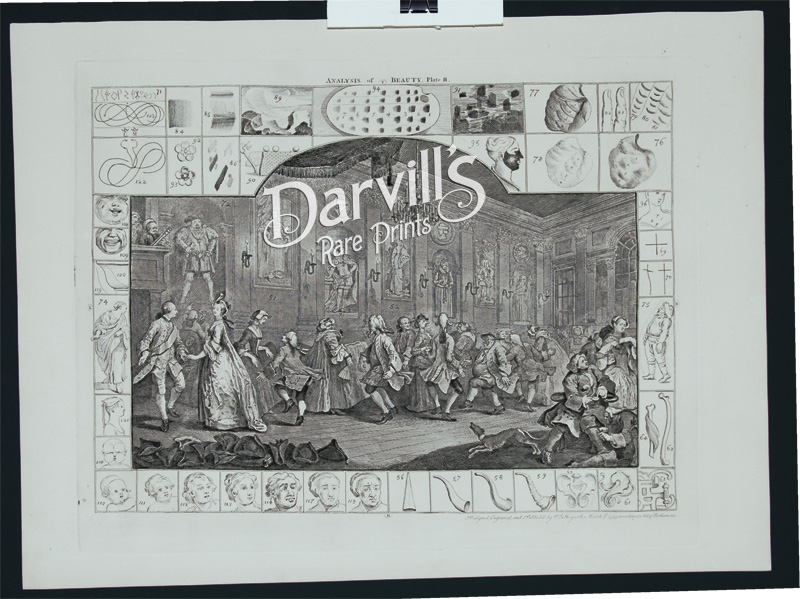 (click image to enlarge— Darvill's electronic watermark does not appear on actual engraving) Analysis of Beauty ANALYSIS OF BEAUTY (PLATE II) Adapted from a design as party of the Happy Marriage series, the engraver's complement to Marriage à la Mode, this plate (which is usually said to represent the Wanstead Assembly with the Earl of Tynley and his household) illustrates Hogarth's theory about the linear presentation of attitude and action:
In the right-hand corner of the print an exchange takes place which is typically Hogarthian in its self-contained, dramatic nature. To her displeasure a young wife or daughter is being compelled to leave the dance by a country squire (complete with dog) who points insistently to his watch. The girl accepts a letter from her lover as she dons her cloak. |
|||||||
Complete set of 2 full page plates Original Copperplate Engraving/Etching from: London. Printed for Baldwin, Cradock & Joy, Paternoster Row $1295.95 Please note: the shipping charge for these plates may need to be adjusted to account for a higher insurance value. (The US Postal Service's Internatonal Priority Mail only allows for $650 insurance to most countries, but service with higher insurance amounts is available at additional cost. Please enquire for service outside of the U.S.) If necessary, we will send you a secure electronic invoice for the additional amount. Please be sure to check your email. Thank you. |
|||||||
|
|||||||