Darvill's Rare Prints, fine antique prints and rare maps since 1918! Darvill's Rare Prints, fine antique prints and rare maps since 1918!
Antique prints from Darvill's since 1918 Rare Maps and Charts Limited edition prints from Alaska's most famous artist Rie Munoz Darvill's Rare Prints homepage About Darvill's Rare Prints
Sorry, we do not perform appraisals and we do not buy from unsolicited sources.

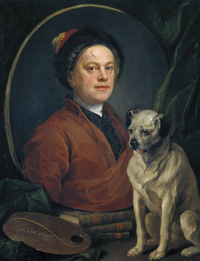
William Hogarth was an English painter and printmaker who poignantly commented the English society of the eighteenth century with biting satire. The career and life of Hogarth were as unusual as his prints.

William was born as the son of a shopkeeper (his mother) and a schoolmaster and publisher. The youth of William was overshadowed by the chronic financial problems of his father, who was even imprisoned because of his debts. This humiliating experience formed Hogarth for the rest of his life.

Hogarth started an apprenticeship as a silversmith in 1714, but never finished it. He then tried his luck as an independent engraver for copper plates. His early commissions were for cards, book illustrations and single prints. In 1720, he registered at the John Vanderbank Art Academy. Around 1726 or earlier, he was taught painting by James Thornhill whose daughter he later married. He earned some reputation for theater decoration paintings.

Hogarth experienced his first big financial success with A Harlot's Progress, a series of paintings from which he produced engravings in 1732. Only the engravings survived. The paintings were lost in a fire in 1755.

A Harlot's Progress is a set of 6 prints about the hapless life of a prostitute. It was a completely new kind of genre prints that were referred as moral history subjects.

After the big success of A Harlot's Progress, Hogarth published a male counterpart series, A Rake's Progress - a story in eight plates showing the decline of a promising young man into a life of drinking and immoral behavior.

In 1743, the painting series Marriage à la Mode was completed. It is considered his masterpiece. In Marriage à la Mode Hogarth turned his satire on the follies of the upper classes. The theme of this series is about marriage for money. Although the prints of Marriage à la Mode sold well, the paintings did not. Therefore all prints designed afterwards, were created exclusively as print designs without any painted counterparts.

In 1747 followed the series Industry and Idleness, a moral story of an idle and an industrious apprentice in twelve plates.

In 1753 Hogarth wrote his book The Analysis of Beauty, a wrap-up of his artistic and esthetic principles.

Hogarth was a very controversial and individual character. Driven by a sense for justice, he missed no chance to get into a quarrel with his contemporaries. His most hated enemy was the British politician John Wilkes, whom he had ridiculed in one of his engravings. William Hogarth died on October 26, 1764.

Humanitarian in impulse, these prints are aimed at the same audience as Beer Street and Gin Lane and employ the same techniques to achieve similar effects. In a passage, just subsequent to his discussion of Beer Street and Gin Lane, Hogarth describes his intentions and his art in this series:

The four stages of cruelty, were done in hopes of preventing in some degree that cruel treatment of poor Animals which makes the streets of London more disagreeable to the human mind, than any thing what ever, the very describing of which gives pain. But it could not be done in too strong a manner, as the most stony hearts were meant to be affected by them....The circumstances of this set, as the two former, were made so obvious for the reason before mentioned that any farther explanation would be needless. We may only say this more that neither great correctness of drawing or fine Engraving were at all necessary, but on the contrary would set the price of them out of the reach of those for whome they were cheifly intended. However what was more material, and indeed what is most material even in the very best prints, viz the Characters and Expressions are in the prints taken the utmost care of an I will venture to say farther that precious Strokes can only be done with a quick Touch would be languid or lost if smoothed out into soft engraving. Fine engraving which requires cheifly vast patience care and great practice is scarcely ever attained but by men of a quiet turn of mind.

Addressing the widest possible audience, composed mostly of members of the servant class, Hogarth tells a melodramatic, simplified story. Using only one main character and the single theme of cruelty, he repeats the theme both from plate to plate and several times within each engraving. Depicting progressively more cruel acts, he avoids either great complexity or subtlety. Deterministic in it movement, the confined, moralistic lesson of this literal exemplum represents an attempt to propagandize the working classes, especially in their attitude to private property.

[Excerpts this page are from Engravings by Hogarth, edited by Sean Shesgreen (Dover, 1973).]

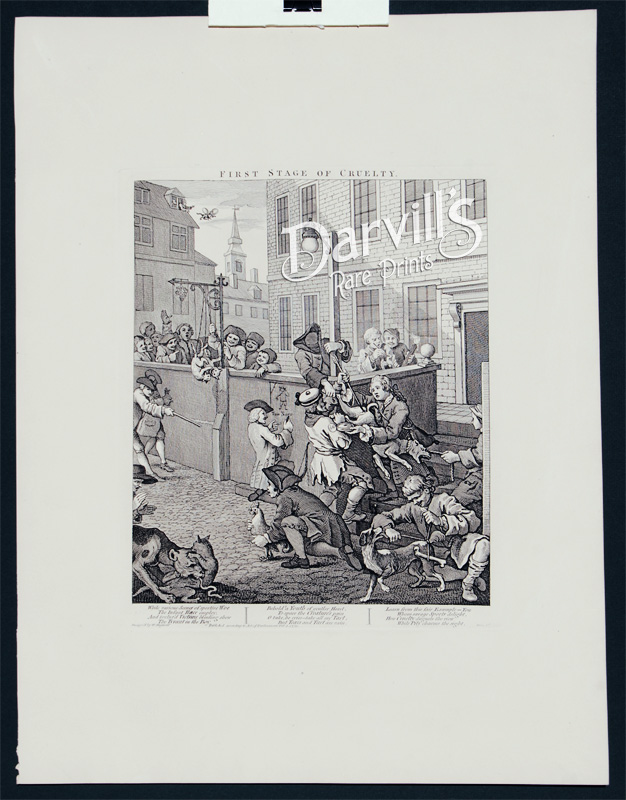
THE FIRST STAGE OF CRUELTY by William Hogarth

(click image to enlarge — Darvill's electronic watermark does not appear on actual engraving)

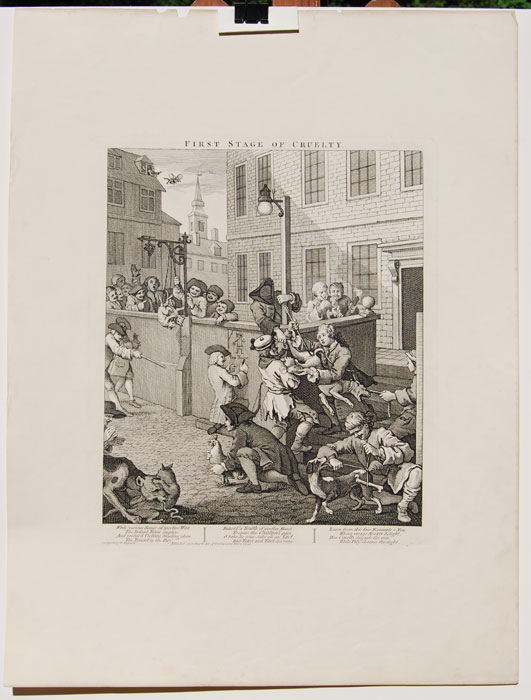
First Stage of Cruelty

Designed by William Hogarth
(Heath edition, 1822)

Sheet size: approx. 25 1/4 inches x 19 1/4 inches
Plate size: approx. 11 5/8 x 14 inches

Condition: Excellent; a few tiny specks in margins. Nice dark impression.

[For sale in a complete set of 4 full page engravings, see below for details]

FIRST STAGE OF CRUELTY (PLATE 1 OF 4)

In this print a number of children visit upon domestic pets the type of savagery traditionally attributed only to animals. They torture them and train them to maim and kill each other. In the center of the scene an orphan boy called Tom Nero and two friends plunge an arrow (tipped with alcohol?) up the anus of a dog. A well-dressed child, possibly the dog's master, attempts to stop the boys by force and bribery. To the left of this group a boy sketches a prophetic stick drawing of "Tom Nero" hanging from the gallows. Above Nero a grinning linkboy watches with sadistic joy as his companion burns out the eye of a captive bird to satisfy his curiosity.

Across from them a group of cheering children watch two suspended cats claw each other in fright. Below them a boy aims a stick at an unsuspecting cock held in position by another youth. To the left a man has set his dog upon a cat while close by a youth ties a bone to the tail of a pup that licks his hand gratefully in response. From a garret two people release a cat on artificial wings in an ill-fated attempt to make it fly.

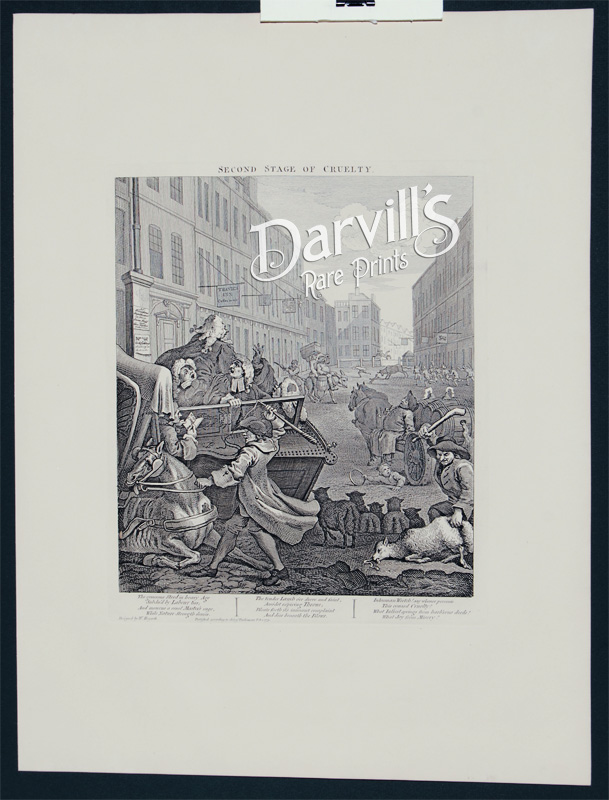
THE SECOND STAGE OF CRUELTY by William Hogarth

(click image to enlarge — Darvill's electronic watermark does not appear on actual engraving)

Second Stage of Cruelty

Designed by William Hogarth
(Heath edition, 1822)

Sheet size: approx. 25 1/4 inches x 19 1/4 inches
Plate size: approx. 11 3/4 x 13 13/16 inches

Condition: Excellent; a few tiny specks in margins. Nice dark impression.

[For sale in a complete set of 4 full page engravings, see below for details]

SECOND STAGE OF CRUELTY (PLATE 2 OF 4)

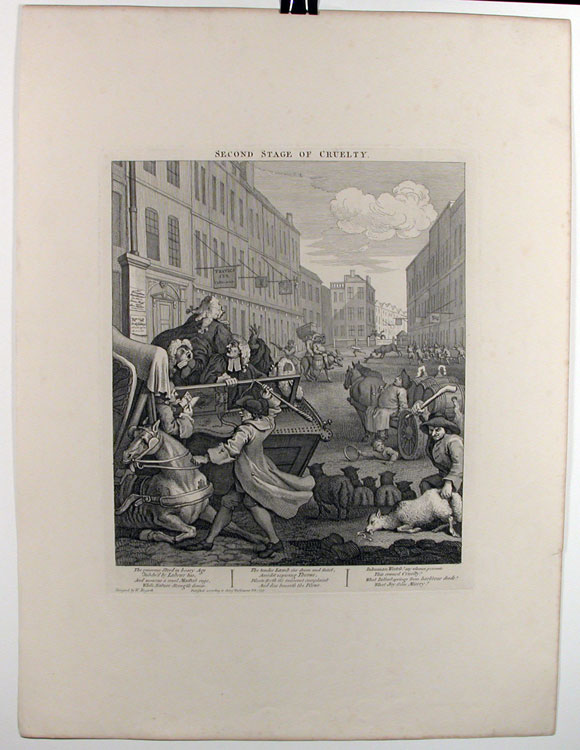
Having become a hackney coach driver, Tom, like his peers, transfers the practice of his cruelty to the animal he encounters in his occupation. By permitting too many stingy barristers to ride his coach for a higher fare, he has caused his horse to break its leg, overturning the carriage in front of the "Thavies Inn Coffee house." As the frightened barristers escape, Tom flogs the animal, senselessly gouging the eye from the crying horse. His name and coach number (No 24 T. Nero") are noted by a benevolent man who will report the fellow to his master.

Various other cruel practices occur around Tom: a drover clubs a tardy lamb (symbol of peace and innocence) to death; a driver of a beer cart, asleep and probably drunk, runs over a fallen child; a man prods an overloaded donkey with a pitchfork; and a mob baits a bull. On the wall stand posters of legitimized cruelty. "At Broughtons Amphitheater...James Field and Geo: Taylor..." announces a boxing match. A sign below it proclaims "Cockfighting."

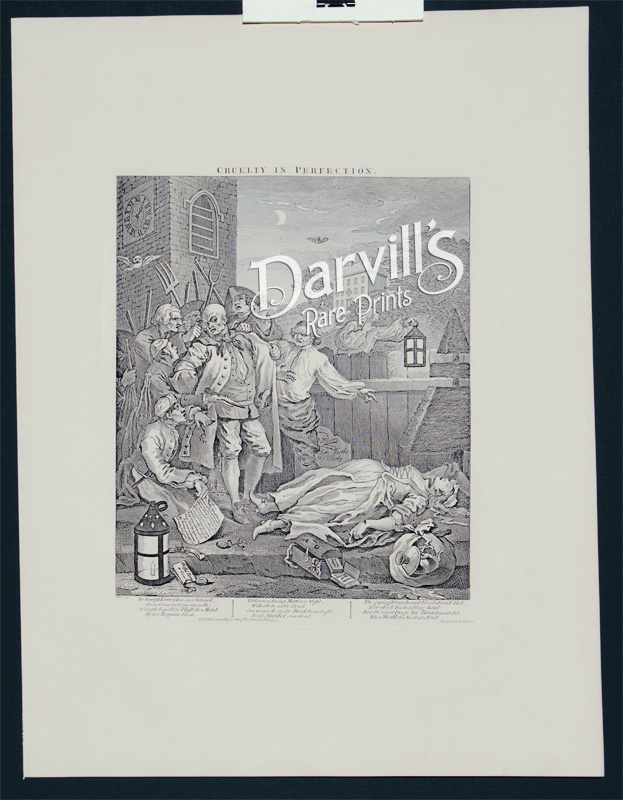
CRUELTY IN PERFECTION by William Hogarth

(click image to enlarge — Darvill's electronic watermark does not appear on actual engraving)

Cruelty in Perfection

Designed by William Hogarth
(Heath edition, 1822)

Sheet size: approx. 25 1/4 inches x 19 1/4 inches
Plate size: approx. 11 11/16 x 13 15/16 inches

Condition: Excellent; a few tiny specks in margins. Nice dark impression.

[For sale in a complete set of 4 full page engravings, see below for details]

CRUELTY IN PERFECTION (PLATE 3 OF 4)

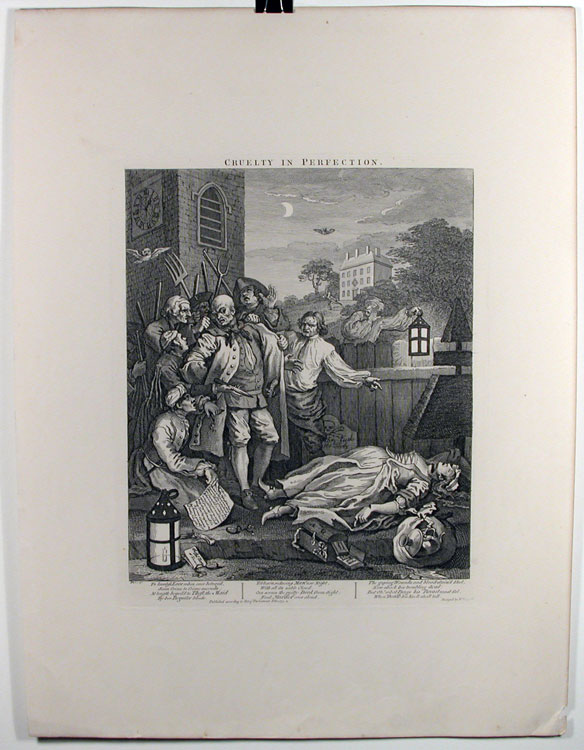
Tom Nero's cruel tendencies have led him to murder. Apprehended in a churchyard at 1 A.M. by a group of outraged farmers, Nero is himself revolted at the sight of the pregnant corpse that he has hacked sadistically and then murdered. The pistols and watches suggest that he has become a highwayman. Over the corpse of his mistress stands a tombstone with the skull and crossbones and the words, "Here lieth the Body." Beside her sits her vanity box (initialed "A G"); her severed hand points to "God's Revenge against Murder" and the Book of Common Prayer. Next to it, in a pool of blood, lies the booty the girl has stolen. A letter "To Thos Nero at P" contains its own special ironies. "Dr Tommy My Mistress has been the best of Women to me, and my Conscience flies in my face as often as I think of wronging her, yet I am resolv'd to venture Body & Soul to do as you would have me so don't fail to meet me as you said you would. For I shall bring along with me all things I can lay my hands on. So no more at presant but I remain yours till Death. Ann Gill."

A bat and an owl hover eerily over the Gothic scene.

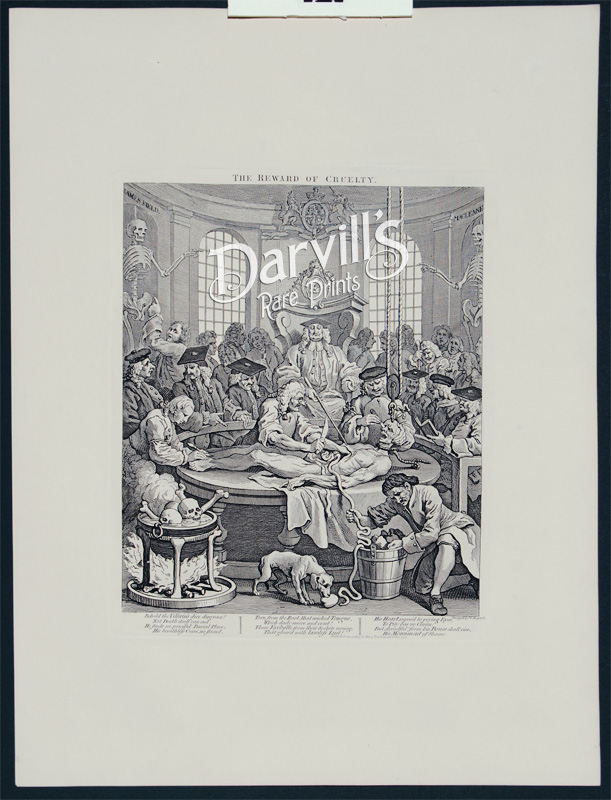
THE REWARD OF CRUELTY by William Hogarth

(click image to enlarge — Darvill's electronic watermark does not appear on actual engraving)

The Reward of Cruelty

Designed by William Hogarth
(Heath edition, 1822)

Sheet size: approx. 25 1/4 inches x 19 1/4 inches
Plate size: approx. 11 3/4 x 14 inches

Condition: Excellent; a few tiny specks in margins. Nice dark impression.

[For sale in a complete set of 4 full page engravings, see below for details]

THE REWARD OF CRUELTY (PLATE 4 OF 4)

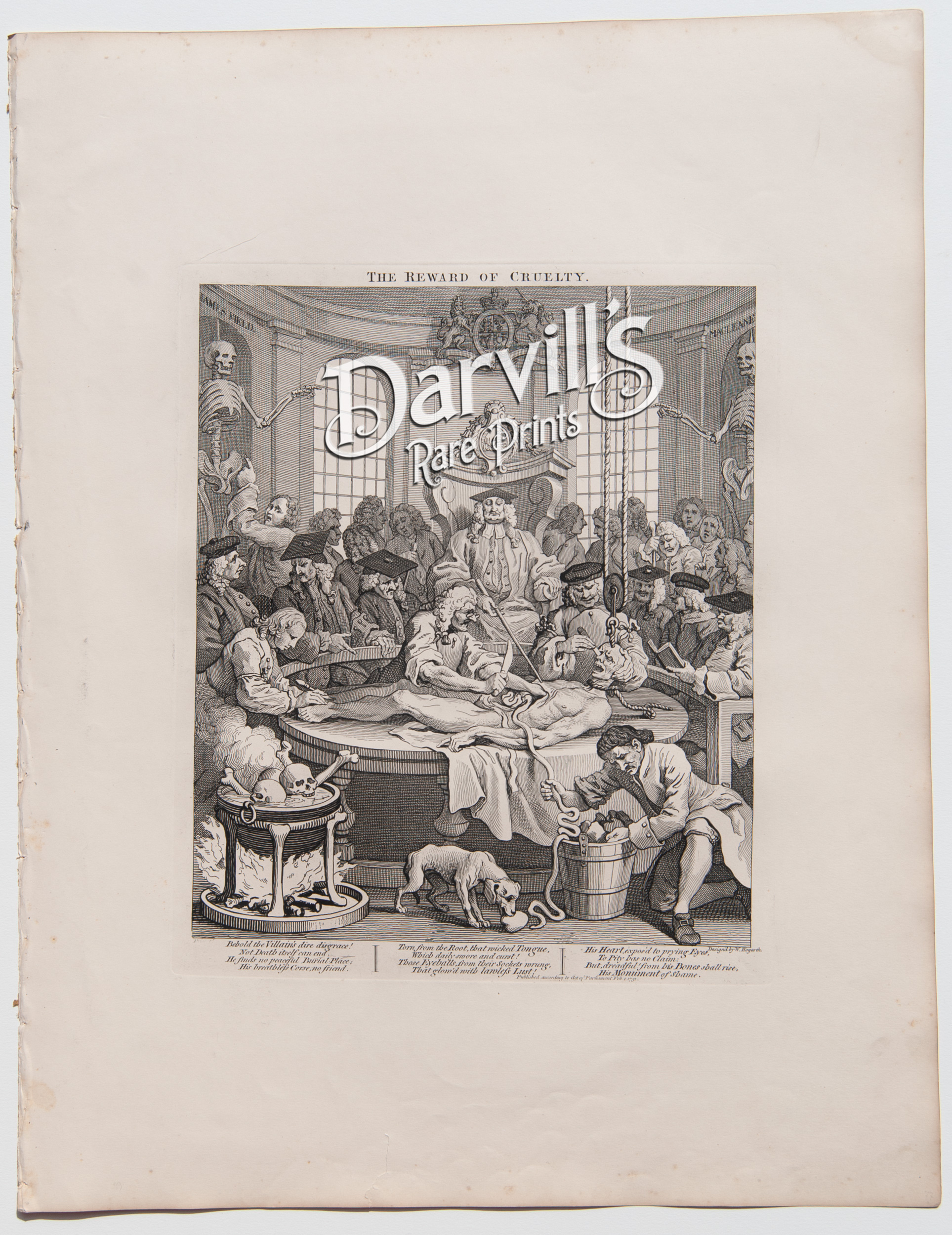
Designed as both a fitting end to Tom Nero's life and as a satire on surgeons, the final scene shows a number of sadistic doctors, oblivious to the grotesqueness of their autopsy, delightedly carving up the corpse of Nero, who appears to suffer at their knives. With a large pulley screw in his head and the hangman's rope around his neck, Tom's body (the initials "T N" appear on his arm) is subject of an anatomy lesson. On surgeon gouges out his eye in much the same way as the boy in Plate I scoops out the bird's eye; a second murderous-looking fellow pulls out his entrails, which a casual assistant puts in a tub; a third carves open his foot. The victim's finger points admonishingly to the boiling pot of skulls and bones which rests on a stand of human femurs. Next to the pot a smiling dog takes his revenge on Tom's cruelty to animals by eating his heart.

The anatomy lesson is narrated programmatically by an impassive figure. Above his head the emblem of the Royal College of Physicians depicting the doctor's hand taking a pulse stands in contrast to the grotesque scene below. Above that hangs the royal arms. The physicians in the foreground read, joke or talk together; those in the background pay no attention whatsoever to the lecture. One figure looks at Tom's corpse and points to the grinning skeleton of "James Field," a famous boxer, as if to suggest that Nero's skeleton will replace Field's. The skeleton of "Macleane," a well-known highwayman, stands in the niche on the right.

Complete set of 4 full page plates
The Four Stages of Cruelty

Original Copperplate Engravings and Etchings from:
The Works of William Hogarth from the Original Plates Restored by James Heath, Esq., R.A.; With the Addition of Many Subjects Not Before Collected: To Which is Prefixed, a Biographical Essay on the Genius and Productions of Hogarth, and Explanations on the Subjects of the Plates by John Nichols, Esq., F.S.A.

London. Printed for Baldwin, Cradock & Joy, Paternoster Row
by Nichols and Son, Parliament Street
— 1822 —

[Interesting side note: this set comes from the collection of Joseph Cunard (1799-1865),
brother of Samuel Cunard — founder of the White Star Line.]

$1500
(sold as a complete set of 4 full page original engravings only,
scroll down for any individual plates that may be available)

  Please note: the shipping charge for these plates may need to be adjusted to account for a higher insurance value. If necessary, we will send you a secure electronic invoice for the additional amount. Please be sure to check your email. Thank you.
INDIVIDUAL PLATES AVAILABLE BELOW


(click image to enlarge)

"First Stage of Cruelty"
(Heath edition, 1822)

Sheet size: approx. 25 1/4x 19 1/4 inches

Condition: Very Good/Excellent: minor chipping/nicks to extreme top edge of paper; usual toning to extreme edges and margins

$325


Second Stage of Cruelty
(click image to enlarge)

"Second Stage of Cruelty"
(Heath edition, 1822)

Sheet size: approx. 25 1/4x 19 1/4 inches

Condition: Excellent

$375


Cruelty in Perfection
(click image to enlarge)

"Cruelty in Perfection"
(Heath edition, 1822)

Sheet size: approx. 25 1/4x 19 1/4 inches

Condition: Excellent

$350


from The Complete Works of William Hogarth
(Mackenzie, London, 1870)
Sold as a set
First Stage of Cruelty
(click image to enlarge)

THE FOUR STAGES OF CRUELY
First Stage of Cruelty


"The Complete Works of William Hogarth"
(Mackenzie, London, 1870)

Sheet size: 8 3/4 x 12 1/4 inches
engraving on steel

Condition: Very Good/Excellent
Slightly grubby margins

(note: entire sheet is too large to scan)

AVAILABLE IN A COMPLETE SET,
SEE BELOW


Second Stage of Cruelty
(click image to enlarge)

THE FOUR STAGES OF CRUELY
Second Stage of Cruelty


"The Complete Works of William Hogarth"
(Mackenzie, London, 1870)

Sheet size: 8 3/4 x 12 1/4 inches
engraving on steel

Condition: Excellent


(note: entire sheet is too large to scan)

AVAILABLE IN A COMPLETE SET,
SEE BELOW


Cruelty in Perfection
(click image to enlarge)

THE FOUR STAGES OF CRUELY
Cruelty in Perfection


"The Complete Works of William Hogarth"
(Mackenzie, London, 1870)

Sheet size: 8 3/4 x 12 1/4 inches
engraving on steel

Condition: Excellent


(note: entire sheet is too large to scan)

AVAILABLE IN A COMPLETE SET,
SEE BELOW


The Reward of Cruelty
(click image to enlarge)

THE FOUR STAGES OF CRUELY
The Reward of Cruelty


"The Complete Works of William Hogarth"
(Mackenzie, London, 1870)

Sheet size: 8 3/4 x 12 1/4 inches
engraving on steel

Condition: Very Good/Excellent
Slightly grubby margins

(note: entire sheet is too large to scan)

AVAILABLE IN A COMPLETE SET,
SEE BELOW


SET OF 4 "STAGES OF CRUELTY" ENGRAVINGS

$275

Return to Hogarth Home

Return to Humor and Satire Page