Darvill's Rare Prints, fine antique prints and rare maps since 1918! Darvill's Rare Prints, fine antique prints and rare maps since 1918!
Antique prints from Darvill's since 1918 Rare Maps and Charts Limited edition prints from Alaska's most famous artist Rie Munoz Darvill's Rare Prints homepage About Darvill's Rare Prints
Sorry, we do not perform appraisals and we do not buy from unsolicited sources.

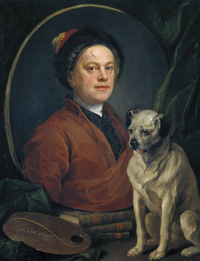
William Hogarth was an English painter and printmaker who poignantly commented the English society of the eighteenth century with biting satire. The career and life of Hogarth were as unusual as his prints.

William was born as the son of a shopkeeper (his mother) and a schoolmaster and publisher. The youth of William was overshadowed by the chronic financial problems of his father, who was even imprisoned because of his debts. This humiliating experience formed Hogarth for the rest of his life.

Hogarth started an apprenticeship as a silversmith in 1714, but never finished it. He then tried his luck as an independent engraver for copper plates. His early commissions were for cards, book illustrations and single prints. In 1720, he registered at the John Vanderbank Art Academy. Around 1726 or earlier, he was taught painting by James Thornhill whose daughter he later married. He earned some reputation for theater decoration paintings.

Hogarth experienced his first big financial success with A Harlot's Progress, a series of paintings from which he produced engravings in 1732. Only the engravings survived. The paintings were lost in a fire in 1755.

A Harlot's Progress is a set of 6 prints about the hapless life of a prostitute. It was a completely new kind of genre prints that were referred as moral history subjects.

After the big success of A Harlot's Progress, Hogarth published a male counterpart series, A Rake's Progress - a story in eight plates showing the decline of a promising young man into a life of drinking and immoral behavior.

In 1743, the painting series Marriage à la Mode was completed. It is considered his masterpiece. In Marriage à la Mode Hogarth turned his satire on the follies of the upper classes. The theme of this series is about marriage for money. Although the prints of Marriage à la Mode sold well, the paintings did not. Therefore all prints designed afterwards, were created exclusively as print designs without any painted counterparts.

In 1747 followed the series Industry and Idleness, a moral story of an idle and an industrious apprentice in twelve plates.

In 1753 Hogarth wrote his book The Analysis of Beauty, a wrap-up of his artistic and aesthetic principles.

Hogarth was a very controversial and individual character. Driven by a sense for justice, he missed no chance to get into a quarrel with his contemporaries. His most hated enemy was the British politician John Wilkes, whom he had ridiculed in one of his engravings. William Hogarth died on October 26, 1764.

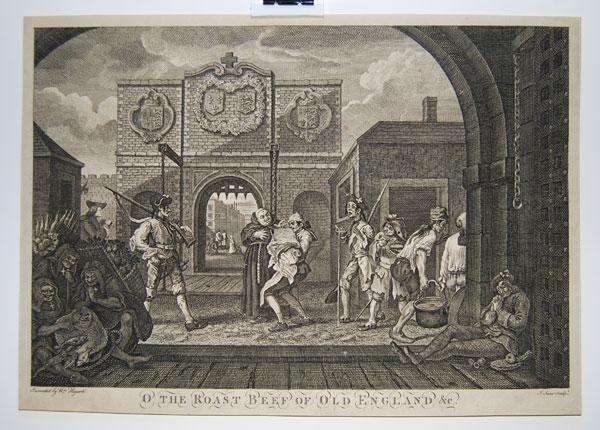
O The Roast Beef of Old England: the gate of Callais

(click to enlarge)

O The Roast Beef of England: The Gate of Calais

An original 18th century print — probably from
"The Moral and Comic Works of the Late Celebrated William Hogarth"
published in 1797 by Laurie and Whittle, Fleet Street, London.
(OR, an earlier print published by Hogarth himself,
inscribed on plate is "Invented by Wm. Hogarth" and "J. June Sculpt."

Sheet size: approx. 10 inches high by 14 inches wide

Condition: Excellent; nice dark impression on slightly time-toned 18th century chain-laid paper with indiscernible watermark

$500


the Gate of Calais
(click image to enlarge)

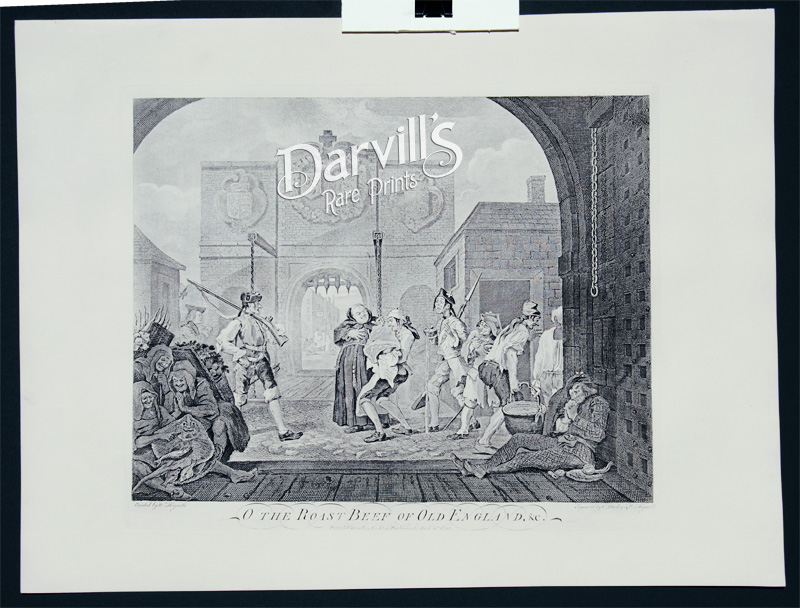
O The Roast Beef of Old England: The Gate of Calais

Original Copperplate Engraving and Etching (by C. Mosely & Wm. Hogarth) from:
The Works of William Hogarth from the Original Plates Restored by James Heath, Esq., R.A.; With the Addition of Many Subjects Not Before Collected: To Which is Prefixed, a Biographical Essay on the Genius and Productions of Hogarth, and Explanations on the Subjects of the Plates by John Nichols, Esq., F.S.A.

London. Printed for Baldwin, Cradock & Joy, Paternoster Row
by Nichols and Son, Parliament Street
— 1822 —

Sheet size: approx. 25 1/4 inches x 19 1/4 inches
Plate size: approx. 17 5/16 x 13 9/16 inches

Condition: Excellent, no flaws to report.

[Interesting side note: this set comes from the collection of Joseph Cunard (1799-1865), brother of Samuel Cunard — founder of the White Star Line.]


$300


The Gate of Calais
(click image to enlarge)

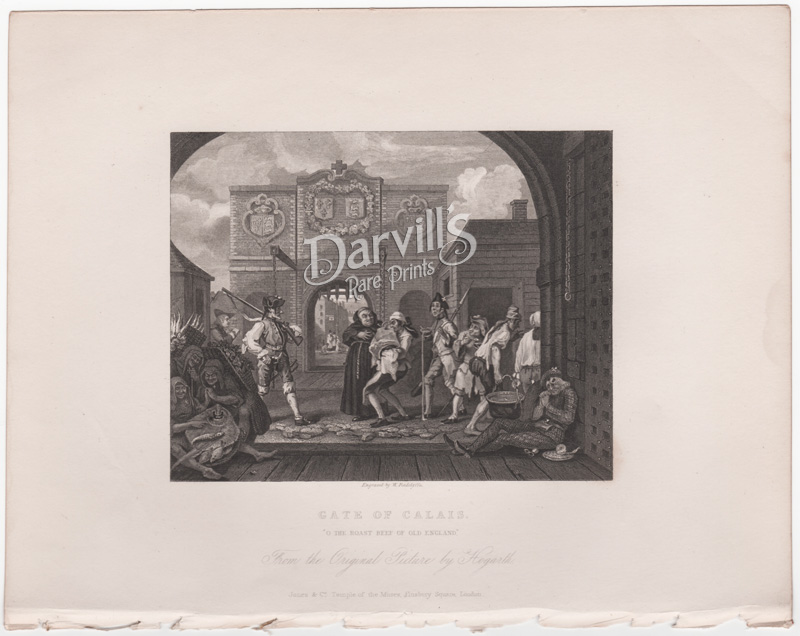
The Gate of Calais

"The Complete Works of William Hogarth"
(Mackenzie, London, 1870)

Sheet size: 8 3/4 x 12 1/4 inches
engraving on steel

Condition: Excellent

(note: entire sheet is too large to scan)


Excerpt from "Engravings by Hogarth" edited by Sean Shesgreen [Dover, 1973]:

"O the Roast Beef of Old England," propagandist in tendency, depicts the French as a starved, ragged people oppressed by their religion and exposed to ridicule by their affectation. The engraved title of the plate comes from a nationalistic anti-French song popular during the period. The following narrative of the print's origins provided by John Ireland may in some measure account for Hogarth's attack on the French in this work:

Ignorant of the customs of France, and considering the gate of Calais merely as a piece of ancient architecture, he began to make a sketch. This was soon observed; he was seized as a spy, who intended to draw a plan of the fortfication, and escorted by a file of musqueteers to M. la Commandant. His sketch-book was examined leaf by leaf, and found to contain drawings that had not the most distant relation to tactics. Notwithstanding this favourable circumstance, the governor with great politeness assured him, that had not a treaty between nations been actually signed, he should have been under the disagreeable necessity of hanging him upon the ramparts: as it was, he must be permitted the privilege of providing him a few military attendants, who should do themselves the honour of waiting upon him, while he resided in the dominions of the Grande Monarque. Two centinels were then ordered to escort him to his hotel, from whence they conducted him to the vessel; nor did they quit their prisoner, until he was a league from shore; when, seizing him by the shoulders, and spinning him round upon the deck, they said he was now at liberty to pursue his voyage without further molestation.

[Ireland, Hogarth Illustrated, I:217-218.]

The scene shows Calais through two jaw-like gates. In the foreground three women, each wearing a cross about her neck, gather enthustiastically (one in adoration) around some fish. They smile at the almost human grin on a skate, unaware of its similarity to their own faces. Tow carry burdensome loads of vegetables; the third is a fishwife. The food they carry and admire represents the normal French fare. Above them Hogarth appears in by a sentry box, sketching the scene. A pike hovers over his head and an arresting hand has been laid on his shoulder. A comparison between the engraver's countenance and those of the other personages in the work suggests the caricatured nature of the latter's faces.

In front of him a ragged soldier (his pants are closed with a wooden skewer, his elbow is out and his ruffles, bearing the proprietary tage "Grand Monarch P," are made of paper) stares in amazement at the beef just arrived from England. The soldier appears to be suspended from the drawbridge chain to suggest the mechanical nature of his role—Paulson calls him a puppet. The butcher, a little less ragged than the other people, staggers under the weight of the meat as he carries it "For Madm Grandsire at Calais," who catered to English visitors. The stout, ugly friar, the only well-fed and well-dressed Frenchman in the scene, rests his fat hand on his chest in an anticipatory way and fingers the meat.

Behind the butcher two more soldiers view the beef. A skinny, unkempt Frenchman with a bayonet on his gun spills his thin soup in awe of the sight. A small fellow with a bullet hole in his hat and a sword that trails on the ground stares at the meat. Two ragged cooks carry off a cauldron of soup; one wears a wig while his shirttail sticks out through a hole in his pants. Below them sits a wounded, anguished Scot, in exile for supporting the Stuart cause. He wears a plaid outfit, worn-out shoes and a sporran with a pipe in it. A cake, an onion and an empty liquor measure lie at his side. The small soldier is by tradition thought to be Irish. That he and the Scot bear marks of battle suggests they have been put in the front lines by the French.

Through the threatening teeth-like gate four people can be seen in the deserted town kneeling serviley for a religious procession that passes before a tavern with the ironic sign of a dove representing the Holy Ghost.
 

Return to Hogarth Home

Return to Humor and Satire Page